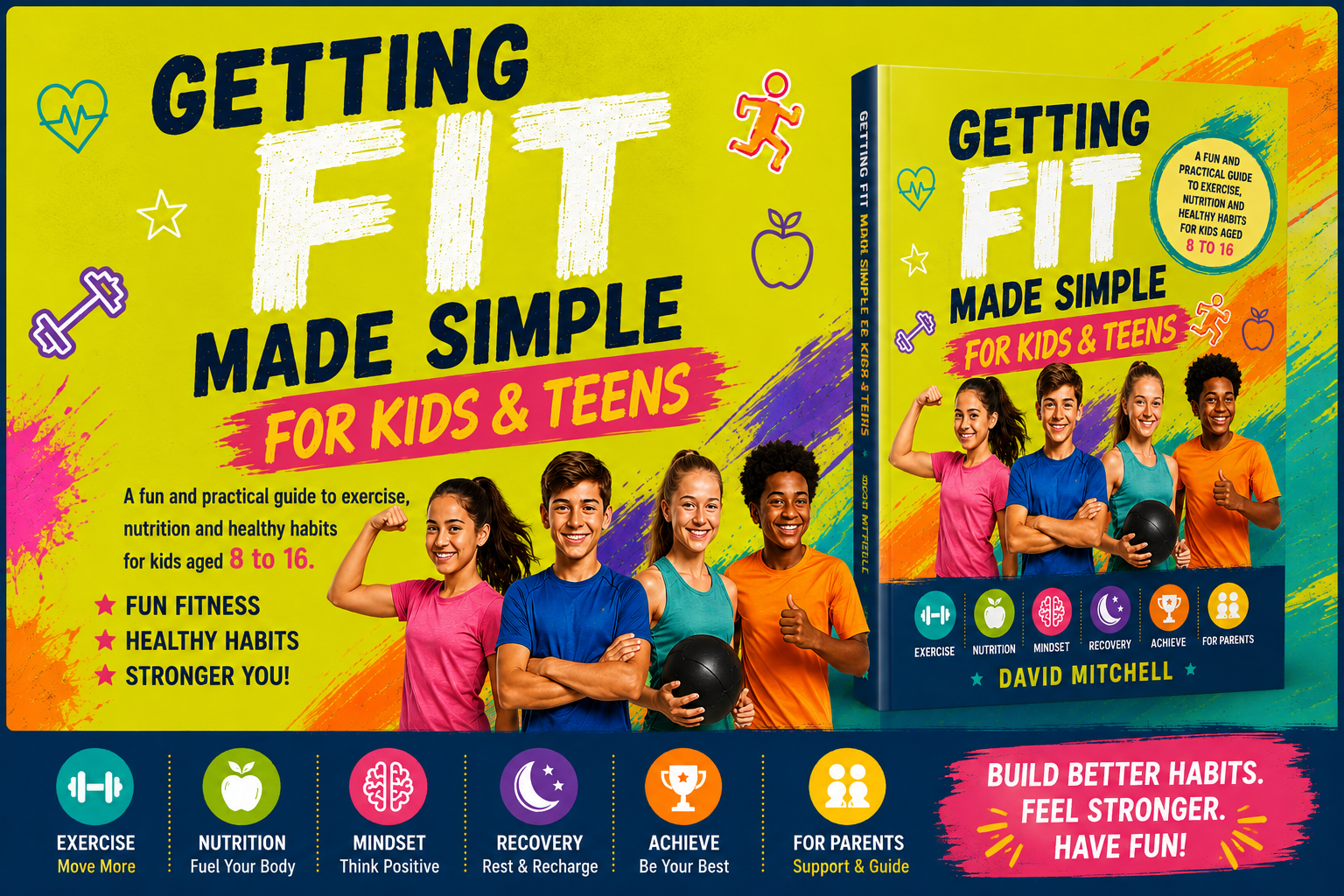
Getting Fit Made Simple For Kids
A Practical Guide to Training and Nutrition
1 Setting The Scene
1.1 Welcome
This book is for boys and girls aged 8 to 16.
Its aim is to help you improve your fitness through exercise and awareness of the foods you are eating or need to eat.
This is not about teaching you how to perform certain sports, though improving your fitness is likely to help you improve your sporting capability.
Fitness is for everyone. You don't need to be sporty or already fit to get started, and you can begin at a level that feels right for you. As you exercise and practise, you can become stronger, fitter and more confident. Most importantly, fitness should be enjoyable, so find activities you like and have fun while you improve.
I have been going to gym classes for years. All the exercises here I have done in an adult class at some time or other. So, these exercises are tried and tested and suitable for anyone not just children.
No weights are used in the exercises here because for children, bodyweight exercises are usually the best place to start as they build strength, balance and coordination while allowing them safely to learn good movement patterns. As they grow and develop, resistance can be introduced gradually and appropriately, with proper supervision and technique.
1.2 What Does "Fit" Mean?
Fitness isn't just about being fast, strong or good at sport. Being fit means being able to move your body, play, exercise and enjoy your everyday activities without getting tired too quickly. It can include strength, stamina, balance, coordination and flexibility. Most importantly, fitness is something that everyone can improve, whatever their starting point.
And importantly:
Being fit isn't about looking a certain way.
1.3 Why Exercise Matters
Being active is good for both your body and your mind. Exercise can help you become stronger and fitter, improve your balance and coordination, and give you more energy for school, play and sport. It can also be a great way to have fun, learn new skills and build confidence. You don't have to be sporty to benefit from being active.
1.4 You Don't Have to Be Good at Sport
Some children are naturally good at football, running or swimming.
But anyone can improve their fitness, it’s not linked to sporting ability.
Fitness isn't a competition.
You can improve regardless of where you start.
1.5 Before You Start
Here are some guidelines to help you as you exercise:
· Learn the movement before trying to make it harder.
· Don't try to copy someone who is much fitter or stronger.
· Take breaks when you need them.
· Drink water.
· If something hurts, stop.
· If you feel dizzy, sick or unwell, stop and tell an adult.
· If you have a health condition or are unsure whether an activity is suitable, speak to your parent/carer and an appropriate health professional.
· Take care of the environment in which you exercise. You don’t want to be bumping into furniture, etc.
1.6 Setting Your Own Goals
Having a goal can give you something to work towards and make your progress easier to see. Your goal could be learning a new exercise, improving something you can already do or completing a challenge. Start with something realistic for you and build from there. Remember, your goal isn't to be better than someone else — it's to improve from where you are now.
1.1 How to use this book
This book is designed to help you learn about fitness, practise exercises and build healthy habits at your own pace. You don't have to read it from beginning to end in one go. Learn the exercises, try the workouts and use the challenges to see what you can improve. Start with the Beginner options, move to Progress when you're ready and take on the Challenge activities when you feel confident.
1.2 A Note for Parents/Carers
1.2.1 Exercise
This book is designed to help children and teenagers aged 8–16 discover that being active can be enjoyable, rewarding and part of everyday life. It is not about dieting, weight loss or trying to look a certain way. Instead, the focus is on building strength, fitness, confidence, healthy habits and a positive relationship with exercise and food.
Children develop at different rates, so the exercises and activities should be adapted to suit their age, experience and ability. Encourage good technique rather than competing over speed or the number of repetitions. The Fun Challenges are there to make activity enjoyable and encourage children to improve against their own previous efforts.
Parents and carers can play an important role by joining in, providing encouragement and helping children make healthy choices. Above all, exercise should be something children enjoy and feel good about. Small, positive habits built over time can provide a strong foundation for an active and healthy life.
If you have any concerns about your child taking part in exercise, or if they have a medical condition, injury or other health concern, speak to a doctor or other qualified healthcare professional before starting a new exercise programme. Children should exercise at an appropriate level for their age and ability, with good technique and plenty of encouragement rather than pressure.
1.2.2 Nutrition
Good nutrition is especially important during childhood and the teenage years because children are growing, learning and becoming more active. The aim is not to put children on diets or make them worry about calories or body weight. Instead, help them develop a positive relationship with food and understand that food provides the energy and nutrients their bodies need.
Try to provide a good variety of foods across the day, including fruit and vegetables, starchy foods, protein foods and dairy or suitable alternatives. Regular meals and nutritious snacks can help keep children fuelled for school, play and sport. Water should be encouraged as the main everyday drink.
Children do not need to eat perfectly. Occasional treats and less nutritious foods are a normal part of life. What matters most is the overall pattern of eating over time. Encourage children to listen to their hunger and fullness, try different foods and enjoy eating together where possible.
For young people who take part in regular or demanding sport, their nutritional needs may be greater. A balanced diet with enough food, fluids and rest is usually the best foundation. If you have concerns about your child's growth, eating habits, energy levels or nutritional needs, speak to an appropriate healthcare or nutrition professional.
2 Your Objectives
2.1 Introduction
Before you start, it can be helpful to think about what you would like to get better at. You might want to become stronger, run for longer, improve your balance, get better at a sport, or simply have more energy and confidence.
You don't need to have one big goal, and your goals may change as you get fitter and learn new skills. The important thing is to choose things that matter to you and to remember that everyone starts somewhere.
Then perhaps:
Your goal doesn't have to be to be the best. It can simply be to be better than you were before.
2.2 Possible Goals
2.2.1 Get Fitter
Getting fitter means being able to move, play and exercise for longer without becoming tired too quickly. It can also mean recovering more easily after exercise and having more energy for the things you enjoy.
For example:
· run for longer
· walk further
· cycle further
· play for longer
· improve your stamina
· recover more quickly
2.2.2 Get Stronger
Getting stronger doesn't mean becoming a bodybuilder. It means making your muscles stronger so that everyday movements and activities become easier.
Examples:
· doing your first press-up
· holding a plank for longer
· doing more squats
· climbing
· carrying things
· jumping
· improving at sport
2.2.3 Improve Your Skills
Fitness isn't just about strength and stamina.
You might want to improve:
· balance
· coordination
· agility
· jumping
· running
· throwing
· catching
· reaction speed
2.2.4 Become Better at a Sport or Activity
You may want to improve at football, swimming, cycling, dancing, athletics, martial arts or another activity. Improving your fitness can help you.
But you don't have to play sport to benefit from fitness training.
2.2.5 Feel More Confident
Learning a new exercise, completing a challenge or discovering that you can do something you couldn't do before can give you a real sense of achievement.
2.2.6 Have Fun and Enjoy Being Active
Exercise shouldn't feel like a punishment. There are hundreds of ways to be active, so find some that you enjoy.
For example:
· games
· cycling
· swimming
· running
· dancing
· walking
· playground activities
· team sports
· individual sports
· exercise challenges
2.3 Setting Your Own Goals
Setting a goal gives you something to work towards. It doesn't have to be a huge goal, and it doesn't have to be about being the fastest or strongest. A good goal is something that matters to you.
There are three simple types of goals you could choose.
Something I Want to Learn
This is about learning a new skill or exercise.
For example:
“I want to learn how to do a proper press-up.”
You might need to practise an easier version first. That's fine. Learning takes time, and every attempt helps you improve.
Something I Want to Improve
This is about getting better at something you can already do.
For example:
“I want to run for 15 minutes without stopping.”
You don't need to achieve it straight away. You could start by running for five minutes, then gradually build up.
Something I Want to Achieve
This is about completing something that gives you a real sense of achievement.
For example:
“I want to complete the four-week fitness challenge.”
Breaking a big challenge into smaller steps can make it feel much easier.
⭐ Start Small
You don't have to make your goals difficult.
Start with a small goal. When you achieve it, set another one.
Every goal you achieve gives you confidence to take the next step.
And remember:
Your goal isn't to be better than someone else. It's to be better than you were before
2.4 Your Goals Can Change
You might start this book wanting to get better at football and discover that you really enjoy running. Or you might begin wanting to get stronger and then decide you'd like to work on your balance and coordination.
That's fine. Fitness is a journey, not a test.
2.5 Remember
· You don't have to be the strongest, fastest or best.
· Your goal is to improve from where you are now.
· Small improvements add up.
· And if you're having fun along the way, you're doing something right.
3 The Exercise Zone 💪
3.1 Introduction
This is where you get to put everything into practice. The Exercise Zone introduces a range of exercises that can help you build strength, fitness, balance, coordination and confidence.
You don't need to be fit or sporty to get started. Each exercise includes clear instructions to help you learn the movement, along with an Easier Option if you're new to it and a Fun Challenge when you're ready to try a little more.
Take your time and concentrate on doing each exercise well. Good technique is more important than doing lots of repetitions. As you practise, you'll become stronger and more confident, and you can gradually move from Beginner to Progress and eventually to Challenge.
There are no prizes for being the fastest or doing the most. Your biggest competition is yourself — see what you can improve!
3.2 Lower Body
Your legs and hips do a huge amount of work every day. They help you walk, run, jump, climb, balance and play sport. These exercises strengthen the muscles in your legs, hips and glutes, while also helping you develop balance and control.
Start with exercises that feel comfortable and concentrate on good technique. As you become stronger, you can gradually make the exercises more challenging.
3.2.1 Sumo Squat