1 Preface
Like many people, I began exercising because I wanted to improve the way I looked. Over time, however, I discovered that fitness is about far more than appearance. It is about health, strength, confidence, independence and enjoying life for as long as possible.
For more than forty years I have trained in gyms, experimented with different approaches to exercise and nutrition, and experienced both success and failure. During that time, I have watched countless fitness trends come and go. Every year seems to bring a new miracle diet, revolutionary workout or "secret" method that promises rapid results with minimal effort.
Most of these promises disappear as quickly as they arrive.
What Really Works in Fitness
What has remained constant are the basic principles of regular exercise, sensible nutrition, adequate recovery and consistency. They are not glamorous, but they work. They always have.
I wrote this book because I wanted to cut through the confusion. Too many people are put off improving their health because they believe fitness is complicated, expensive or only for young, athletic people. It isn't.
Whether you are taking your very first steps towards a healthier lifestyle, returning to exercise after many years, or simply looking for a straightforward guide that avoids unnecessary jargon, this book is for you.
You will not find miracle diets, impossible workout schedules or unrealistic promises within these pages. Instead, you'll find practical advice based on experience, supported by established fitness principles and presented in a way that is easy to understand and apply.
My hope is that this book helps you develop habits that last a lifetime rather than enthusiasm that lasts a few weeks.
You don't have to become an athlete to improve your health. You simply need to start, remain consistent and allow time for the results to come.
If this book encourages even one person to become stronger, healthier and more confident than they were yesterday, then writing it will have been worthwhile.
Good luck on your journey.
David Mitchell
2 Setting The Scene
2.1 Introduction
The purpose of this book is simple: to help you improve your fitness, health, body composition and overall quality of life—even if you're not yet sure exactly what you want to achieve.
This book is written for beginners and for people who already exercise but feel frustrated by a lack of progress. You don't need to be young, athletic or highly experienced to benefit from the principles in these pages.
The advice in this book is based on over forty years of personal experience with strength training, cardiovascular fitness, nutrition, recovery, and fat loss. Over that time, I have seen fitness trends come and go, but the fundamentals that truly work have remained remarkably consistent.
One important point must be made from the outset: this book does not include a diet.
Diets are usually short-term interventions that people eventually abandon. This book is different. It is about building sustainable habits and making long-term lifestyle changes that improve your health, strength, mobility, confidence, and energy levels over time.
Success will require commitment and consistency.
There is no magic shortcut.
However, the rewards can be substantial:
· Improved fitness and mobility
· Greater strength and endurance
· Better body composition
· Increased confidence
· Better mood and lower stress
· Improved long-term health
This book has intentionally been kept concise and practical. Most people do not need hundreds of pages of theory. They need clear guidance on what actually works. For that reason, you will find:
· straightforward explanations
· practical advice
· bullet points for key information
· additional detail is placed in appendices for optional reading
Before we begin, I'd like to introduce a simple model that summarises the book's philosophy.
Think of fitness as building a house. A strong house needs solid foundations. Likewise, lasting fitness depends on getting the basics right before worrying about advanced training techniques.
The Fitness Pyramid illustrates those foundations.
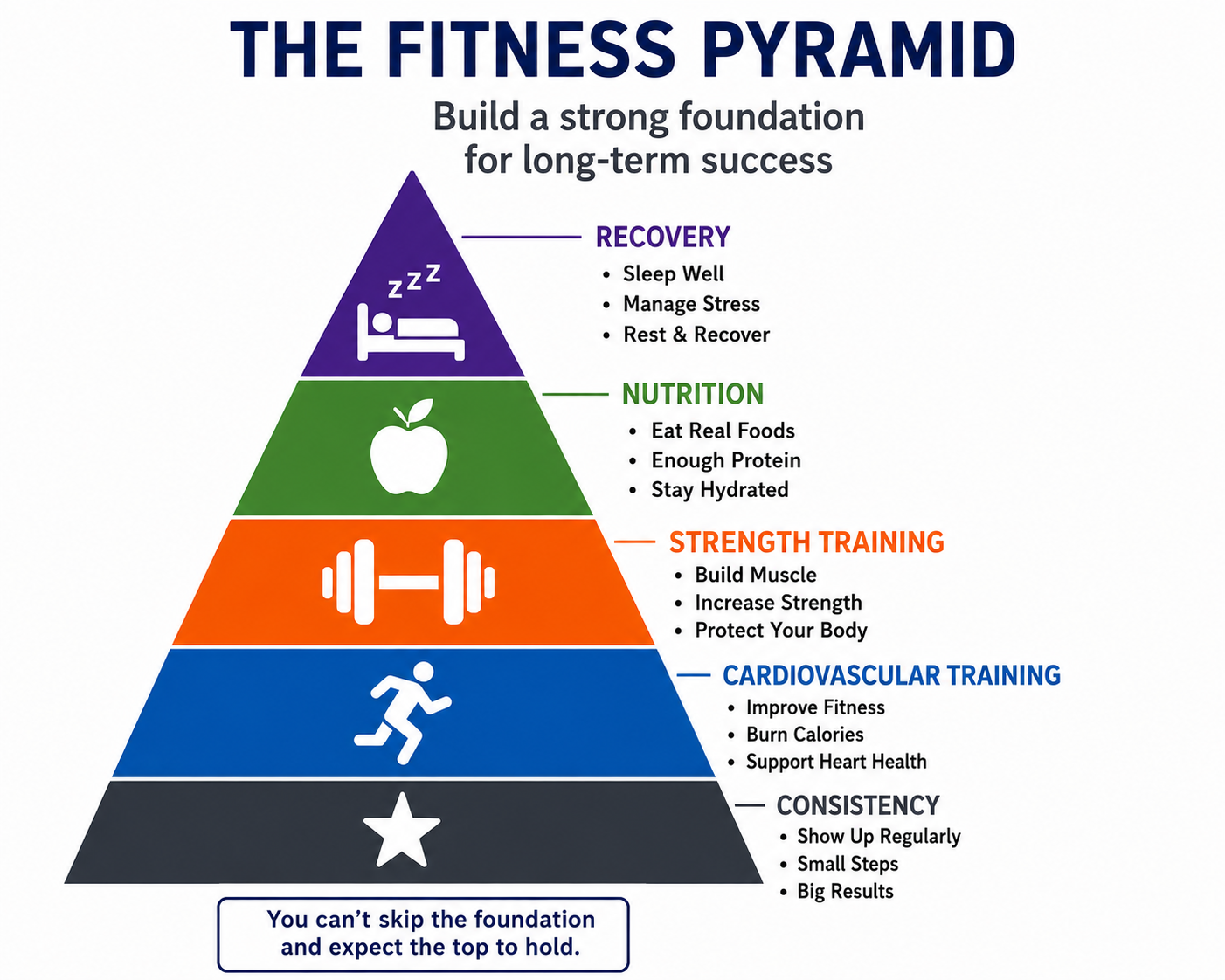
Rather than overwhelming you with endless workout routines and complicated meal plans, this book focuses on the principles that consistently produce results. To help you get started, I've also included sample upper-body and lower-body workouts, see Appendix D: Typical Workouts. You will also find countless instructional videos online.
Key points made throughout the book are highlighted in bold and listed in Appendix A: Key Points Listed for your ease of reference.
The appendices contain additional information that supports the main text. Read through the book first, then dip into the appendices whenever you'd like more detail.
Before continuing, there are a few important points to clarify:
· This book is not about bodybuilding or Olympic weightlifting.
· The advice applies equally to both men and women, but it is not intended for children.
· If you have concerns about beginning an exercise programme, consult your GP or healthcare professional first.
· If you experience sharp pain, dizziness, nausea, or feel unwell during exercise, stop immediately, rest, hydrate and assess whether it is safe to continue.
· The terms “strength training” and “resistance training” mean the same thing here.
· Measurements may occasionally switch between metric and imperial units for practicality.
· Some smartphone apps are recommended. Many are free, although certain features may require payment or subscription upgrades.
· All product names and brands mentioned remain the property of their respective owners and are included for informational purposes only.
2.2 The Four Elements
Long-term fitness isn't achieved by focusing on one area alone. Lasting results come from balancing four key elements that work together to improve your health, fitness and body composition.
These four elements are shown below.
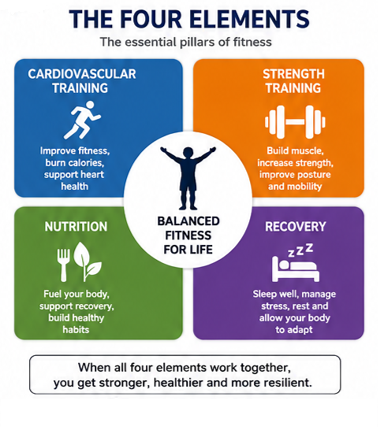
Think of these four elements as the pillars that support your fitness journey. Ignore one of them, and your progress is likely to slow. Master all four, and you'll give yourself the best chance of long-term success.
Each element is essential and described in detail below in the following sections.
These four elements are interconnected. Focusing on only one while neglecting the others will almost always limit your progress.
For example:
· fat loss without strength training often leads to muscle loss
· exercise without proper nutrition limits progress
· training without adequate recovery increases fatigue and injury risk
Consistency across all four areas is what produces lasting results.
Imagine someone who exercises five days a week but eats poorly and sleeps only five hours a night. Despite working hard, they are unlikely to achieve the results they expect because two of the four elements are missing.
The following chapters explore each element in detail before bringing everything together into a practical plan that you can immediately begin. By the end, you'll understand not only what each one does, but how they work together to produce lasting results.
2.3 Final Thoughts
Fitness isn't one thing done exceptionally well. It's several simple things done consistently well.
Remember, you don't have to master everything in this book today. Focus on making one small improvement at a time.
3 Your Objectives
3.1 Introduction
Before beginning any fitness programme, it's worth taking a few minutes to decide what success looks like for you.
Many people start exercising with only a vague idea of their goals. They may simply want to “get fitter,” “lose weight,” or “tone up.” While these are understandable starting points, clearer objectives usually lead to better decisions, better motivation, and better long-term results.
People often pursue fitness for several common reasons:
· improving overall health
· reducing stress and improving mood
· increasing confidence and self-image
· increasing energy levels
· building structure and routine into daily life
· improving strength, mobility, and independence
· improving long-term quality of life
Your own goals may be different, and that is perfectly fine. What matters is that you think honestly about what you want from this programme.
By picking up this book you've already taken the first step. Now it's time to decide where you want that step to lead.
3.2 Possible Objectives
Let's look at some of the most common fitness goals and what they really mean.
3.2.1 Lose Weight
When people lose weight, they're not always losing fat:
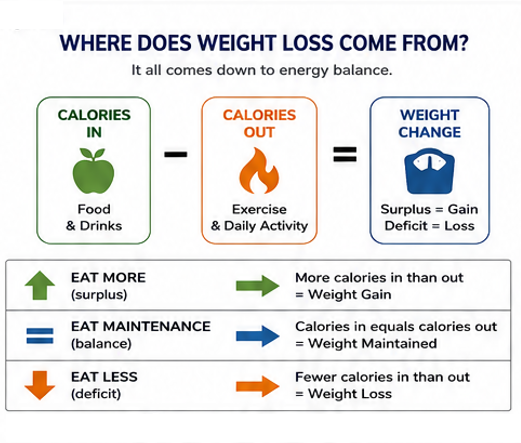
“Losing weight” is one of the most common fitness goals, but on its own it is not always a good objective.
For example, rapidly losing ten pounds might sound appealing — until you realise much of it could be muscle rather than fat.
This matters because muscle plays a vital role in:
· strength and mobility
· metabolic health
· calorie burning
· protecting bone density as we age
After the age of thirty, adults naturally lose muscle mass over time unless they actively train to preserve it. Reduced muscle mass can also contribute to weaker bones and increased frailty later in life.
The goal should therefore not simply be “weigh less,” but rather:
· reduce excess body fat
· maintain or increase muscle
· improve overall health and function
3.2.2 Tone Up
“Toning up” is another very common goal, but it is often misunderstood.
In reality, “toning” usually means some combination of:
· losing body fat
· increasing muscle definition
· improving muscle shape and firmness
The challenge is that fat loss and muscle gain do not always work in the same way:
· fat loss requires a calorie deficit
· muscle growth is supported by adequate nutrition (including extra calories) and resistance training
Understanding this balance is central to achieving lasting results.
3.2.3 Get Fit
“Getting fit” means different things to different people, but for this programme, fitness can be thought of as:
having the strength, endurance, mobility, confidence, and health to live the life you want without your body holding you back
Fitness is not simply about appearance. It is about capability, independence, resilience, and quality of life.
3.2.4 Reach a Healthy Body Mass Index (BMI)
Some people may choose to aim for a healthier Body Mass Index (BMI).
BMI is a simple calculation based on height and weight that places people into categories such as:
· underweight
· normal weight
· overweight
· obese
Although BMI has limitations — particularly for highly muscular individuals — it can still provide a useful general guide for most people, including your GP.
Many apps, websites, and smart scales can automatically calculate BMI.
You could use your BMI to determine your target body weight (i.e. in the “normal” BMI range.)
3.2.5 Burn Fat and Build Muscle
In my view, this is one of the best overall objectives because it addresses:
· health
· body composition
· appearance
· strength
· confidence
As body fat decreases and muscles become more visible, many people experience major improvements in self-image and motivation.
Exercise also provides benefits beyond physical appearance:
· improved mood
· reduced stress
· increased energy
· better sleep
· greater sense of structure and progress
This is the objective that this book is primarily designed to help you achieve.
3.3 A Personal Story
At the time of writing, I am 74 years old.
Ten years ago, I was diagnosed with Non-Hodgkin lymphoma, a cancer affecting white blood cells. My treatment involved multiple rounds of chemotherapy and a stem cell transplant. One phase of treatment was particularly aggressive, involving large bags of chemotherapy drugs literally labelled “poison.”
Like many people facing serious illness, there were days when I wondered whether life would ever return to normal.
While isolated in hospital, I found an unused exercise bike on the ward and began doing short sessions of high-intensity cycling with headphones and music blasting. Those sessions transformed my mood and energy levels each day.
When I was discharged, doctors expected recovery to take six to nine months.
Instead, I returned to the gym and resumed full workouts within ten weeks.
Fitness cannot prevent illness entirely but being physically active and resilient can dramatically improve recovery, mental strength, and overall wellbeing.
Today, I am fully recovered. Looking back, I don't believe exercise cured my cancer—but I do believe it helped me cope with treatment, recover more quickly and regain my confidence.
3.4 Another Personal Story
A few years ago, I suddenly developed severe pain and weakness in my left thigh. Walking even short distances became difficult and standing for more than a few seconds was painful.
At first, I rested completely, assuming the problem would resolve itself.
It did not.
After several months, I became increasingly discouraged and worried that I might permanently lose my mobility and independence.
So, I cautiously returned to the gym. I could still cycle, and although climbing the stairs to the gym was difficult, I managed it. I began using seated upper-body machines and gradually reintroduced movement into my routine.
Almost immediately, I noticed improvements in my mood and outlook. Over time, I slowly rebuilt my strength, reintroduced leg exercises, and soon recovered fully.
Doctors had planned spinal surgery, but I ultimately cancelled it.
I cannot fully explain why exercise helped so much, but I firmly believe that movement, strength training, and the psychological benefits of exercise played a major role in my recovery.
3.5 Final Thoughts
For most people, the key components of long-term fitness success are:
· building or maintaining muscle
· reducing excess body fat
· improving cardiovascular fitness
· supporting recovery and overall health
As you work through this book, keep your objectives clearly in mind. They will remind you why you started and help keep you moving forward when enthusiasm fades and consistency becomes the key to success.
Take a few minutes to write down your answers.
My main reason for getting fitter is:
In twelve months, I would like to be able to:
The first habit I will start this week is:
4 Element 1: Strength Training
4.1 Introduction
Many people ask:
“Why do I need more muscle?”
The answer is simple: muscle is essential for health, movement, independence, and long-term quality of life.
From around the age of thirty onwards, most people gradually lose half a pound to a pound of muscle mass every year unless they actively train to maintain it. This process accelerates with age and contributes to:
· weakness
· reduced mobility
· slower metabolism
· increased injury risk
· poorer balance
· reduced bone strength
Regular strength training helps counteract these problems by:
· preserving and building muscle
· strengthening bones and connective tissue
· improving balance and mobility
· increasing calorie burn
· supporting healthy ageing
Muscle is metabolically active tissue, meaning it requires energy even when you're resting. The more muscle you have, the more calories your body generally burns throughout the day.
Strength training is not just about appearance — it is about capability and resilience.
The obvious venue for strength training is the gym. However, the gym is not for everyone for various reasons: I’ve never been to a gym; I don’t know what to expect; I don’t know how to train; too many people there; too expensive; nothing suitable locally; etc. That’s OK, you can still achieve your fitness objectives, so I’ve given some ways to start without a gym – see Appendix H: Pre-Gym Options.
You will still need to pay attention to the other three Elements described below.
4.2 A Note for Women
Some women worry that strength training will make them look excessively muscular.
Developing large amounts of muscle requires years of highly specialised training, strict nutrition, and often exceptional genetics. For most women, strength training simply leads to:
· improved body shape
· better posture
· greater strength
· increased confidence
· healthier body composition
You remain fully in control of how far you wish to progress.
4.3 Gym Training
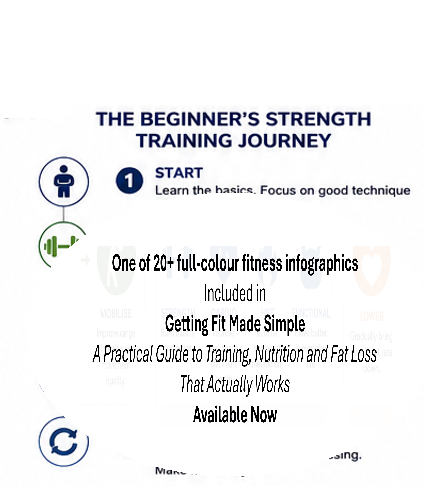
This diagram illustrates the steps to strength training, and these are developed in the sections below.
4.3.1 Choosing a Gym
If you are considering joining a gym, spend time finding one that suits you.
A good gym should feel:
· clean
· welcoming
· safe
· practical for your schedule and travel arrangements
Modern gyms usually include:
· resistance machines
· dumbbells and barbells
· cable machines
· cardio equipment
· stretching areas
· group fitness classes
If you are thinking about joining a gym for the first time for some strength training first a bit of information about the kind of kit you will find there - see Appendix E: Gym Equipment.
You’re not going to be lifting huge weights. Modern kit like that in the photos allows weight to be set just by moving the yellow pin – see Weight Block on page 109.
Also, on the chrome bars at the top, you can see smaller weights that can be added - 2.5 and 5 pounds (1.13 and 2.67 kilos). So, you can typically increase the weight by just 2.5 pounds a time.
Note also the instruction panel on the right.
Look for features like these if you are checking out a new gym.
Most gyms offer classes. The style of class can vary from gym to gym and trainer to trainer: circuit training; yoga; high intensity interval training; strength training; Pilates; etc.
How will you get there and back? Cycling, walking or jogging could increase your calorie burn and warm you up / cool you down. If driving, check parking availability and charges.
Most gyms offer new members an induction. This might be a good time to discuss your plans with a personal trainer or fitness instructor. Also, what classes might suit you.
4.3.2 Getting Started With Strength Training
So, you've decided to join a gym. If you're already an experienced gym user, that's great. If not, here's how to get started.
A basic beginner programme should include:
· a warm-up
· several simple exercises
· manageable weights
· good technique
· gradual progression
· cool-down
For strength training you will need a few workouts – for examples, see Appendix D: Typical Workouts.
To create your own workouts, you have options:
· splash out and pay for a personal trainer (typically £30 - £40 an hour).
· use Zing(£35 a year) to generate workouts for you with demonstration videos (on your smartphone) showing how to do the exercises. See Appendix J: ZING for more about Zing. (N.B. Zing does not cover cardio exercises but it’s fine for strength training).
· use ChatGPT AI to generate a workout for you “create a 60-minute upper body gym workout” - if you are unfamiliar with the exercises or the kit there are plenty of online videos.
· Many excellent online resources provide demonstrations of exercise technique. Search for the name of any exercise and you'll usually find several high-quality instructional videos.
If you are going to be working with dumbbells, barbells and gym machines, a pair of gym gloves will protect your hands and reduce the risk of damaging any rings you may wear and possibly your nails.
4.3.3 Building A Strength Workout
Let’s look at how a workout should be structured.
To begin, you should start with a warmup to get your muscles ready to work and to reduce any risk of injury. You’ll find plenty of these online but also see Warm Up Before Strength Training.
Next, I recommend 5 -10 minutes of cardio: bike; treadmill; rowing; stepper; etc. This brings your heart rate up ready for work. No need to go full out just enough to get you a bit sweaty.
Now for the resistance exercises. It’s customary to split these into upper and lower body.
Upper body areas are:
· Chest
· Shoulders
· Back
· Biceps
· Triceps
Lower body areas are:
· Quads
· Hamstrings
· Calves
· Lower back
· Abdominals
It’s your decision but if you are new to the gym I would suggest initially doing one exercise for each of the five areas. Do one upper body and one lower body session each week.
If you are more experienced do two exercises per area and make your own decision how many times a week you exercise. Do not exercise the same muscle group on consecutive days – recovery time is important. Be sure to keep one full day of rest.
For more exercises see Arnold Schwartzenegger's book in Appendix C: Further Reading.
Finally, you should do a cool-down. If you look online, you’ll find demonstration videos but see Stretching After Strength Training.
4.3.4 How Much Weight?
So, you are sitting on a machine for the first time – but how much weight should you use and how many reps (repetitions) are needed?
Choose a weight that allows you to complete 8–12 repetitions with good technique while making the final few repetitions feel challenging.
Another way to choose your weight is to look at your One Rep Maximum (1RM).
Set a low weight on your exercise machine and do one rep. Great. Now increase the weight and do a rep. Repeat until the weight is too heavy. The last weight you could lift is your 1RM.
Training weight = 65 - 80% of your 1RM.
4.3.5 How Many Repetitions?
For repetitions most people do three sets of 8-12 repetitions. Rest one minute between sets and two minutes between different exercises.
If you are not feeling any discomfort the weight is too light – what next? Increase it!
Concentrate on your breathing: breath out as you lift the weight (aka the concentric movement); breath in as the weight is released (aka the eccentric movement). This is important because as your body comes under stress, there can be a tendency to hold the breathe – which is unhelpful!
You should move the weight through a full range of motion.
Drink plenty of water throughout.
When lifting:
· move smoothly
· avoid jerking movements
· control the weight throughout
· avoid swinging your body
· keep your spine stable
· use a full range of motion where appropriate
If you are having to use your body to move the weight, it’s too heavy – you are risking injury – reduce the weight.
There is no prize for lifting excessively heavy weights with poor technique.
Controlled movement builds better results.
Good technique is more important than a big weight.
Note that the first set of any exercise is often the most uncomfortable. Don’t be put off. Once you start working your muscles they send for reinforcements which, when they arrive, reduce the difficulty.
Finish off your workout with a cool-down routine.
Once I’ve left the changing rooms I like to sit down for a few minutes, reflect on my workout and drink my protein shake as a reward for my hard work.